Businesses often attempt to maximise profits for owners or shareholders by taking measures to reduce costs. A reactive approach to plant and equipment breakdowns is very costly, and it reduces outputs. By failing to do what it takes to become proactive, they take risks against the odds of frequent failure, high repair and downtime costs.
A proactive approach is more productive, predictable and less expensive, as it relies on strategic maintenance to increase equipment life and running times, reduce failure risk, and lower operating costs.
Efficiency
Efficiency derives from executing work with the least expenditure of resources, money, labour, and so on.
In maintenance and reliability, the common ways to improve efficiency, save money, and reduce expenses include:
- planning your work so that it can be done in the least amount of time
- scheduling the work at times that will disrupt production the least
- providing the parts needed for that maintenance work in a timely manner
Planning and Inventory Management
Often overlooked is the benefit of combining two processes in two mutually dependent areas: inventory management and maintenance planning.
The latter is needed to help in forecasting demand, while the former is needed to satisfy that demand. Sadly, they are often, I dare say usually, tackled independently simply because they are managed by different departments with different priorities.
Without coordination you get too much inventory and carrying costs, too little inventory, or the wrong inventory, coupled with excessive levels of downtime while waiting for parts.
Sometimes planning is only used for proactive work because its timing is predictable. In those cases, and if your planning is largely for repair work in response to breakdowns, then there is much room to improve.
Breakdowns are difficult to forecast, so parts and materials stores end up being rushed in at high cost, or overstocked with “just-in-case” items. Neither is a good approach, so what’s the solution?
Effectiveness
In many, not all, cases, breakdowns can be avoided. Doing so reduces disruption and its resultant loss of output. Proactive maintenance enables that. Through it, you control the consequences of failures, even in cases where the failures cannot be completely avoided.
Also, the more proactive your maintenance programme is, the more accurate your materials forecast becomes, lowering the risks of stock-outs.
Many failures occur randomly, but also give advanced warning. You can use that to add some predictability to random spares demands. You move from frequent and costly surprises to something more predictable.
You need to be doing the right maintenance, being more effective.
Planning, scheduling, demand forecasting, materials provisioning, and defining the right proactive work to perform must all be done together to generate the most value.
The total value generated is greater than the sum of its parts, usually by a large margin.
Spotting the Opportunities
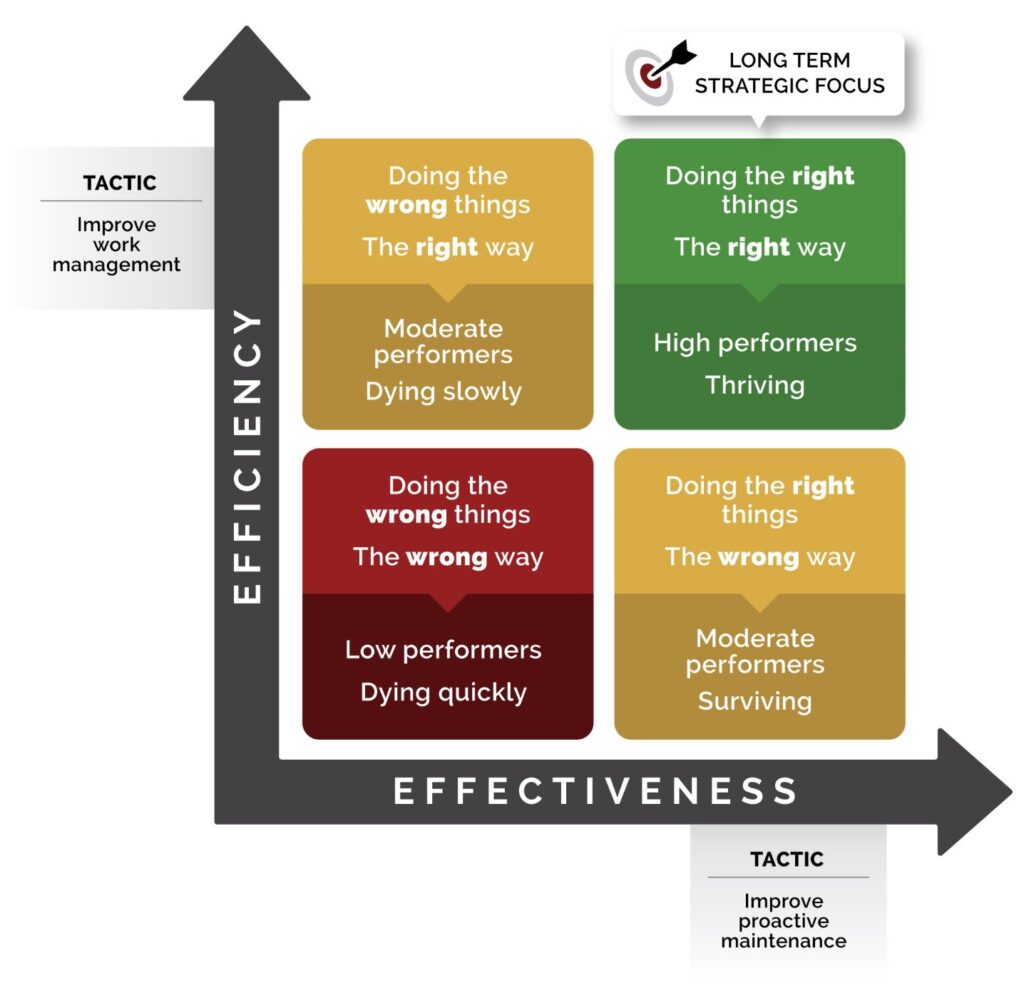
Many organisations underperform as they still manage both maintenance and reliability with a traditional “break-then-fix” approach. That is shown in the lower left quadrant in the figure below.
Mapping Where You Are
Caption:
Efficiency and effectiveness determine whether maintenance activity protects performance or simply consumes resource.
Alt text:
Matrix showing efficiency and effectiveness in maintenance performance, with low performers, moderate performers, and high performers mapped by doing the right things the right way.
Failures to plan and schedule will frustrate your skilled trades workforce. They won’t be able to start and finish without interruptions from other “emergencies,” and they’ll experience a lot of waiting around, mostly for parts. That wastes their time, and no one likes that.
They will be hindered from getting to needed proactive work due to all the urgent breakdowns. They know there is room to improve, but on their own, they can’t solve it. It is a management problem. If it has been that way for long, then there may also be a culture of mediocrity, although no one would actually say that.
Improvements in how work execution is managed take time. Knowledge needs to change. Old, and often dysfunctional, behaviours will need to change.
When on the right track, efficiency improves, and your work crews can get to the proactive maintenance that has been ignored. As they do that, you should see some gains in reliability, if they are doing the right maintenance.
Lower Left: Doing the Wrong Things the Wrong Way
Doing the right work requires knowledge of failure mechanisms, reliability methods, and tools. We usually find these capabilities missing in organisations that are in the lower left quadrant.
Planning and scheduling are more easily understood, so improvements in doing the right proactive maintenance are often tackled later, if at all.
In fact, when organisations see improvement based solely on work management, they are taking a low-risk path. Improvement tends to be slow, and it rarely reaches the full potential available. Yet small improvements often seem to be enough for many managers to claim success and earn that next promotional opportunity.
Upper Left: Doing the Wrong Things the Right Way
Where there is an understanding of reliability, organisations often begin to use manufacturer’s recommendations.
In some cases, these are good. In most others they are lacking, but they do provide a starting point. You will gain some benefit but not full potential.
Most manufacturers do not operate and maintain the equipment they design and build, so their insights into what goes wrong can be lacking. Without the right sort of effort to identify the most appropriate maintenance tactics, performance gains will be somewhat limited.
In the figure, those organisations are in the upper left quadrant, doing some of the wrong things, but doing them well.
Lower Right: Doing the Right Things the Wrong Way
Not surprisingly, organisations with strong engineering cultures are very capable of identifying the right work to do if they utilise the established methods properly.
They also risk being overly technical in their approach and missing failures that result from human error, or they can misunderstand the impact of failures on the business. Only operations really knows that.
It’s not unusual to find that stronger engineering oriented organisations end up either over-maintaining or under-maintaining. While they do make improvements, they often fail to achieve optimum results.
In those cases, they tend to move towards the lower right quadrant, doing many of the right things, but executing the work poorly. Why?
Upper Right: Doing the Right Things the Right Way
Moving to the upper right quadrant requires work on technical, process, and people elements.
We’ve seen several organisations whose strong technical solutions achieved little because they completely missed the human element required to implement those changes.
The most effective reliability improvements begin with a focus on functions, then identifying and managing risks to minimise consequences of failures, coupled with improvements in work management processes and practices.
It’s about moving out of firefighting mode and shifting to the upper right quadrant by doing the right things the right way.
Getting There
Good management of work and its execution maximise available workforce utilisation.
By doing the right proactive maintenance, unexpected failures are avoided, consequences are managed, and risks are mitigated. Costs are lower while output capacity is higher. Morale is better among operators and maintainers. The organisation is on its way to becoming a high performer.
But without sufficient mandate to achieve that and the needed cross-functional authority to make it happen, organisations usually fail to achieve it. This is not a task that can be delegated to a single department.
Your results depend on which quadrant you can attain and sustain.
If your business is low margin or struggling with difficult markets, you probably can’t afford to be wrong here. You need to be in the high-performance, upper right quadrant.
If you are enjoying high margins and lots of demand, profitability is increased no matter what you do, so you can afford to be sloppy. But unless you are in that upper right quadrant, you could be doing much better.